WATS Package Map
Canonical dependency map and per-package status for the WATS workspace.
applies to 0.4.x-alpha-tooling · reviewed 2026-05-04
The canonical dependency map for the WATS workspace. Arrows point from dependent package to dependency. The graph is generated from the package manifests at build time — it cannot drift from the code.
Dependency graph
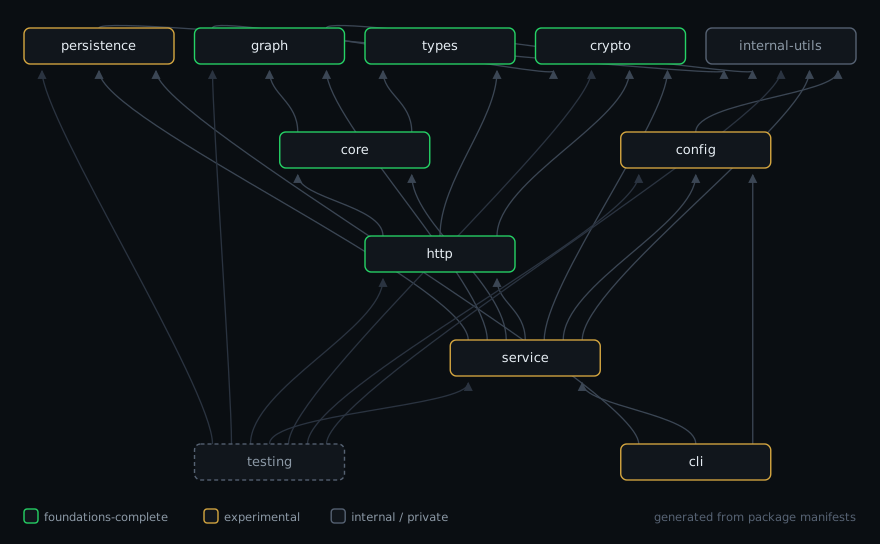
@wats/internal-utils is a published internal support package used by public runtime packages that need shared helpers. It exists so registry installs resolve; it is not a stable application API.
Packages
@wats/types
Shared TypeScript domain contracts for config, webhook envelopes, messages, statuses, contacts, entities, and error payloads.
- Runtime targets: Bun, Node, Workers, Deno.
- Public: yes.
- Dependencies out: none.
- Stability: foundations-complete.
@wats/crypto
CryptoProvider seam plus Node/Bun and WebCrypto adapters.
- Runtime targets: Bun, Node, Workers, Deno.
- Public: yes.
- Dependencies out:
@wats/typesfor shared error payload contracts. - Stability: foundations-complete.
@wats/graph
Graph client, transport seam, endpoint registry, scoped clients, error registry, pagination, and endpoint catalog.
- Runtime targets: Bun, Node, Workers, Deno through injected
Transport/ fetch. - Public: yes.
- Dependencies out:
@wats/types. - Stability: foundations-complete for client/transport/errors/pagination; endpoint breadth is expanding.
Runtime endpoints and helpers:
POST /{phoneNumberId}/messagesPOST /{phoneNumberId}/marketing_messagesviasendMarketingTemplateandPhoneNumberClient.sendMarketingTemplate(...)PhoneNumberClient.sendText(...)for arbitrary-recipient text startsPhoneNumberClientcomposer helpers for media, location, contacts, reaction, interactive variants, template send, mark-as-read, and typing indicators- Template Group helpers for Graph
template_groupsandtemplate_group_analytics(listTemplateGroups,getTemplateGroupAnalytics) - profile/commerce mutation helpers for Graph
whatsapp_business_profileandwhatsapp_commerce_settings(updateBusinessProfile,updateCommerceSettings) via root@wats/graphand@wats/graph/endpoints/business-management; WATS mapsprofilePictureHandleto Graphprofile_picture_handleandisCartEnabled/isCatalogVisibletois_cart_enabled/is_catalog_visible - business-management helpers for Graph
block_users,official_business_account, andnew_display_name(listBlockedUsers,blockUsers,unblockUsers,getOfficialBusinessAccountStatus,requestOfficialBusinessAccountReview,submitDisplayNameForReview) - Groups helpers for Graph
groups,invite_link,participants, andjoin_requests, includingPhoneNumberClient.createGroup,PhoneNumberClient.listGroups,PhoneNumberClient.group(groupId), andGroupClient GET /{wabaId}/phone_numbers
Endpoint subpaths:
@wats/graph/endpoints/messages@wats/graph/endpoints/media@wats/graph/endpoints/templates@wats/graph/endpoints/flows@wats/graph/endpoints/calling@wats/graph/endpoints/business-management@wats/graph/endpoints/groups@wats/graph/node-media(Node/Bun-only; filesystem path media helpers; not imported by the root/browser-safe entrypoint)
Run bun run api:check after changing this list. It verifies package exports, source files, fixture imports, docs, and the changelog all agree on the same Graph endpoint subpaths.
Media runtime:
uploadMediasends a single multipartPOST /{phoneNumberId}/mediawith strict validation and finite upload caps.downloadMediaresolves media metadata viaGET /{mediaId}.downloadMediaBytesfetches resolved media bytes through the injected transport with finite download caps and optional SHA-256 verification.deleteMediacallsDELETE /{mediaId}.decryptEncryptedMediaverifies and decrypts encrypted media bundles.createUploadSession,uploadFileToSession, andgetUploadSessionimplement resumable upload sessions.
@wats/http
Application-edge webhook package: challenge/signature primitives, runtime-neutral WebhookAdapter, and Bun/Node/Fetch wrappers. It verifies signatures and normalizes raw webhooks into typed updates via @wats/core's normalizeWebhookEnvelope before dispatching them to a structural { dispatch(update) } facade-like object.
- Runtime targets: Bun, Node, Workers, Deno-style Fetch runtimes.
- Public: yes.
- Dependencies out:
@wats/crypto,@wats/core,@wats/types. - Layer: application-edge — composes
@wats/core(NOT a peer of@wats/graph; it sits above@wats/core, while@wats/graphsits below it). - Stability: foundations-complete.
@wats/http depends on @wats/core for the normalizer. Its adapter accepts only a structural { dispatch(update) } facade-like object at runtime.
@wats/core
Typed webhook normalization, typed filters, raw filters, routers, listener registry, and WhatsApp facade composition root.
- Runtime targets: Bun, Node, Workers, Deno where dependencies are available.
- Public: yes.
- Dependencies out:
@wats/types,@wats/graph. - Stability: foundations-complete.
The facade binds a GraphClient, optional PhoneNumberClient / WABAClient, a TypedRouter, and optional listener registry support. WhatsApp.sendText(...) (alias startChat(...)) delegates through the bound PhoneNumberClient to send a text with any valid phone-number-like recipient — no contacts lookup. Facade composer helpers (media, location, contacts, reaction, interactive variants, template send, mark-as-read, typing indicators) require a bound phoneNumberId and use the same phone-number client.
@wats/config
YAML/JSON config schema, env-secret references, config loading, validation, and redaction.
- Runtime targets: Bun and Node-compatible ESM; config parsing itself is runtime-light.
- Public: yes, experimental.
- Dependencies out:
@wats/internal-utilsfor shared object guards. - Stability: experimental until the CLI/service config contract settles.
@wats/cli
Package-manager CLI surface for safe config validation, OpenAPI export, help, and local webhook token generation.
- Runtime targets: Bun now; Node-compatible ESM is the direction for the publishable CLI.
- Public: yes, experimental.
- Dependencies out:
@wats/config,@wats/service. - Stability: experimental until init/doctor/serve process behavior settles.
@wats/service
Runtime-neutral standalone webhook/API service foundation plus generated OpenAPI 3.1 document for the service routes.
- Runtime targets: Bun and Web Fetch-compatible runtimes for the core
Request -> Responseapp; Node/Bun server wrappers are later work. - Public: yes, experimental.
- Dependencies out:
@wats/config,@wats/core,@wats/http,@wats/graph,@wats/crypto. - Stability: experimental until CLI serve/openapi integration and broader route coverage settle.
@wats/persistence
Experimental persistence contracts, the SQLite local adapter, and the Postgres adapter, plus the migration runner, webhook/service idempotency records, message projection, and outbox record APIs.
- Runtime targets: Bun for
@wats/persistence/sqlite;@wats/persistence/postgresruns whereverpgdoes; root contracts andrunOutboxWorkerOnceare TypeScript-only. - Public: yes, experimental.
- Published subpaths:
@wats/persistence,@wats/persistence/sqlite,@wats/persistence/postgres. - Future subpaths:
@wats/persistence/testing. - Dependencies out: none.
- Dependency direction:
@wats/serviceconsumes@wats/persistencethrough injected stores, not direct env reads. - Stability: experimental until outbox/service enqueueing and live Postgres validation settle. The Postgres adapter is shape-only, mock-client tested; no default CI runs a live Postgres service.
@wats/internal-utils
Internal support package for shared pure helpers required by public runtime packages.
- Public: yes for package-manager completeness; do not treat it as stable public API.
- Published: yes, because
@wats/configdepends on it at runtime. - Dependencies out: none.
@wats/testing
Private workspace tests, consumer fixtures, fixture payloads, and policy checks.
- Runtime targets: Bun test runner only.
- Public: no.
- Published: no.
- Dependencies out: workspace packages under test.
Invariants
@wats/typeshas no runtime dependencies.@wats/graphand@wats/cryptoexpose portable seams and keep runtime-specific behavior behind adapters.@wats/httpalso keeps its runtime wrappers behind adapters, but it is an application-edge package that composes@wats/core(it is not a foundation peer of@wats/graph).@wats/coreis the core composition root; app-layer packages compose it rather than duplicating router/webhook semantics.@wats/internal-utilsmay be published only as an internal support package;@wats/testingstays private and is never published.- Consumer fixtures import through package specifiers, never relative source paths.
Runtime-target matrix
| package | Bun | Node | Workers | Deno | notes |
|---|---|---|---|---|---|
@wats/types | Y | Y | Y | Y | type-first |
@wats/crypto | Y | Y | Y | Y | adapter chosen at runtime |
@wats/graph | Y | Y | Y | Y | injected transport |
@wats/http | Y | Y | Y | Y | runtime wrappers |
@wats/core | Y | Y | Y | Y | no server binding |
@wats/config | Y | Y | possible | possible | boundary validation; file loading runtime-dependent |
@wats/persistence | Y | Y | N | N | SQLite and optional Postgres adapters are server/runtime-side |
@wats/cli | Y | planned | N | N | config validation + OpenAPI export + package-manager UX |
@wats/internal-utils | Y | Y | possible | possible | internal support package |
@wats/testing | Y | N | N | N | Bun tests only |
@wats/service | Y | planned | possible | possible | runtime-neutral app plus OpenAPI generator; server wrappers later |